
Can new towns contribute identity, not just amenity?
From 2006 to 2007, the Now Institute acted as consultant and advisor to the city of Madrid in an investigation on the Spanish new town model. Madrid Now analyzed the generic new town plan for opportunities to inject specificity, diversity and identity for future residents.
The city of Madrid currently hosts a housing program called PAU (Programa de Actuación Urbanística) or Programs of City-planning Performance that was designed to provide high-quality, affordable housing for an increasing population of young couples with financial challenges. The procurement system is through a lottery system and no choice of PAU or building is given; it is a random selection that currently requires a long wait.
The critique of the PAU system is multiple: The prescriptive parceling limits flexibility and integration with future commercial, civic and cultural programs that require different massing and siting. The low density negates the potential for high density development and exacerbates the horizontal growth of the city. The current strategy is indifferent and unresponsive to the local surrounding context and urban culture, thereby denying its ability to differentiate and iconize.
Three sites were recommended by the city for exploration and intervention. Each of the sites held a particular problem and urban responsibility which drove the design strategy and development. One site became a hub for increased efficiency in transportation. Another became an off-grid urban farm community, while the last proposed options for an alternative high-density residential lifestyle.
Infrastructure: Transportation
Madrid’s infrastructure developed from a radial, centralized city but is expanding to accommodate the emerging megalopolis. Many pre-20th century European cities are facing similar strains on their infrastructure as they prepare to support future growth and expansion. WhileMadridproper has 3 million inhabitants, it is consistently used by a population of 5.8 million. The shape and form of the city is continually shifting: from an individual urban center to one of multiple nodes. Unfortunately, many of the satellite communities that have sprouted still rely on the historic core ofMadrid, further straining existing infrastructure. Highways are clogged, subway lines need extending and other methods of transport need investigating (light rail, easier access to airport, etc.) AsMadridgrows from an established focal point into a sieve of mega-city dimensions, it must be complimented with an infrastructural counterpart to act as connective tissue between nodes of activity.
Madridhas taken measures to accommodate such expansion. It has built more than 120 kilometers of subway in 10 years (compared to the 8 years it tookTorontoto create the 5.5 km Sheppard subway). More tracks, along with new light rail lines and buses, are on the way. In the mid-1990s, the city’s suburban population began to expand with increased immigration from Latin America, Eastern Europe andNorth Africa. By 1995,Madridcompleted a 10-kilometer extension of the circle subway line. Alberto Ruiz-Gallardon, then president of the regional government and nowMadrid’s mayor, has been instrumental in further expanding such public infrastructure. Under his purview, 56.3 kilometers and 38 new stations were built by 1999. By 2003, the government had created an additional 54.6 kilometers of new rail, much of it linking centralMadridto the Southwest suburbs. The city now has 220 kilometers of subway rail and is almost finished building another 47.4 kilometers of subway and 45 kilometers of light rail in suburban areas. The national government, responsible for highways, is building 200 kilometers of bus-only lanes. A new airport, theMadrid-BarajasInternationalAirportopened in 2006 with a shuttle from the nearest metro station.
Dubbed the “Madrid miracle,” this is in large part due to the transit agency’s willingness to experiment with public-private partnerships. One of the new subway lines is operated by a private firm with a long-term lease, andMadridis now building several massive underground bus interchanges, with private investment. Many bus routes in the region are also run by private firms. Another reason for success: Spain’s government has simply made public transit a priority, and voters have too.
Sources:
Statistical Yearbook 2006
Boletín estadístico delMinisterio de Fomento. Renfe, INE Difusión, www.ine.es/infoine, Copyright INE 2007
RENFE OPERADORA: Dirección de Comunicación, Marca y Publicidad.
Empresa Municipal de Transportes deMadrid, SA (EMT) resource
Atlas de las actividades económicas de la Comunidad de Madrid. Dirección Gral. De Economia y Planificación, CAM, 2002.
Área de Gobierno de Seguridad y Servicios a la Comunidad. Dirección General de Movilidad. Resumen de la MemoriadelServicio de Estacionamiento Regulado.
Nature: Green Space
Madrid enjoys one of the most extensive areas of parks, gardens and “green zones” of all European cities. Madridis now officially one of the greenest cities in the world, thanks to energetic programs for planting a multitude of trees, flowers, and grasslands organized in the last decade by the Comunidad de Madrid. Currently, 3,300 hectares of parkland are distributed throughout more than 40 parks within the urban limits, providing 11.5 m2 of green space per capita (compared withParisandLondonthat provide 8 and 9 respectively). The parks are all quite different and have added elements to give them character and identity. Some parks, such as Casa del Campo and the Retiro, have been around for centuries but new green zones are springing up annually and the overall change from just a few decades ago is remarkable.
Madrid is not resting on its laurels, however. There are two green projects underway of note. The first is an effort to create a “green cycling loop” along the M-30 highway: a 60.7 km continuous cycling route that will circle the city and link existing surrounding parks. Creating such a route will extend out into secondary routes through surrounding parks, spreading throughout the region along old livestock trails, rural roads and existing cycling routes, linking currently separated open spaces, parks and sporting areas. This linear park will be used by both the city and its outlying communities.
The Mercamadrid expansion project is also underway. This city is creating a 194,000 m2 green corridor that would connect two existing parks, in total increasing the city’s green surface area by 453,000 m2. This is 25% of the present area! The project’s new swath of green will link the Parque del Manzanares to the Parque Forestal de Entrevías. The Mayor hopes this will help Madrid grow in green area but also in products, infrastructures and logistics facilities. Investing 300 million euros, the city hopes the new green area will house 200 new companies and create 1,400 new jobs. Thus, Mercamadrid’s slogan: “we grow with Madrid”.
Sources:
Área de Gobierno de Medio Ambiente y Servicios a la Ciudad. Dirección General Patrimonio Verde
Dirección General de Protección Ciudadana. Vicepresidencia Segunda y Consejería de Justicia e Interior.
Nature: Water
Today, Madrid has many water sources. For centuries, however, the only system of supplying water was a series of waterways coming from the northwest of Madrid, from which water would flow from rainfall or when defrosted from the Guadarrama mountain range. The waterways, located underground, were 7- 12 kilometers, provided roughly 2,150 m3/year and were used until the 1850s. In 1858, due to population increase and further demand for water, CANAL DE ISABEL II was created to divert water from the Lozoya River. Later these streams were concretized as water channels and today flow through pipes.
Unlike other European cities,Madrid’s water supply is not under the purview of the City Council. Due to historic reasons, the drinkable water supply and water cycle in the region is managed by a public sector company, Canal de Isabel II (CYII), belonging to the regional government. Canal de Isabel II (named after the Spanish queen who reigned in the Ninetieth century) is responsible for 161 municipalities and 5.211.343 inhabitants, 96% of the CAM population.
The CAM territory, of which 88% of the total population is located in the city ofMadrid’s metropolitan area, is contained in theTajoriver basin. 70 km of this river and its tributaries Jarama (161 km), Guadarrama (145 km) and Alberche comprise theCAMhydrographical network, each of them with their own tributaries. Although mostly situated in a basin, there is a significant mountainous area, divided in two zones, the North Mountain Range and the West Mountain Range. Together, they comprise the Sierra de Madrid (peaks over 2200 meters). The middle and southern areas of the city are flatter and form part of the plateau of La Mancha and La Alcarria.
In general,Madridcan be considered as having a semi-arid Mediterranean climate, with cold winters and very hot and dry summers. Sierra de Madrid usually blocks the rain fronts. The rainfall average per year is1000 mmin the mountains yet less than 450 mm in the Southeast. The heat island effect in the city results in a greater average temperature and a lower air absolute humidity.
The CAM water use can be divided in the following way: resource production area (north, north-east and north-west), consumption area (MadridCityand its metropolitan area) and the dumping area (Manzanares, Jarama and Guadarrama low stretches). In 1960, the present water supply system of the City ofMadridwas set up. In 1975, there was a major reorganization to become more regulated, followed in 1977 with a commitment to treat sewage and water.
Today, the principle streams, reservoirs and aqueducts are: the reservoir in the meadow of Chamartín (1399), the high Abroñigal next to the bridge of the abroñigal stream and now the M-30 higway, (1613), the UNDER ABROÑIGAL in the street of Alcala (1557), the CASTILIAN SOURCE in House of Maudes (1621), the HIGH OF the RETIREMENT in the west of the pine of Chamartín (1631), UNDER the RETIREMENT (OROPESA) near Tetuán (1631), AMANIEL, near the cemetery of Fuencarral, SAN DAMASO (BUTARQUE) (1407), in the black Hill (Under Carabanchel), RETAMAR (1829), in the stream of Great Rock (the Brown), the SOURCE OF the HEALTH, in the park of the West, the SOURCE OF the KING (1596), finished in the Source of the King (old ctra. of Castile).
(“Fat” Waters). Also Source of the Watercress, Source of Leganitos, Contreras, Source of Reina, Old Prado of San Jerónimo, Sewers, Count of Salt mines, Pajaritos, Flours, General Hospital, Atocha, Shells, Nepturno, Toledo, Unions, Pascualas, Meaques, House of Cows, Source of the Zacón, Source of Húmera, Source of the House of Field.
In year 1858 the Channel of Isabel II was inaugurated.
High altitude, the climate ofMadridis characterized per dry and warm summers. a province that offers of average 300 days of sun to the year and with average temperatures of 10ºC in winter and 27ºC in summer.
Sources:
Anthony Ham, “Pain inSpain: lesson for all,” The Age Company, 2007.02.10, <http://www.ipcc.ch/Home/World>
Jose Gil & Hugo Lucas, “Spain: New Plan for Renewable Energy,” Renewable Energy Access, 2005.11.11, http://www.renewableenrgyaccess.com
http://ec.europa.eu/energy/energy_policy/facts_en.htm
Ministerio de Medio Ambiente, Instituto Nacional de Meteorología
Canal de Isabel II, barometro de economiaurbana
National Statistics Institute
Regions: Statistical yearbook 2005, Eurostat Commission.
Culture: History
The capital of Spain since 1562,Madrid is centrally located in the Iberian Peninsula. Uniquely, the city of Madrid acts as both the capital of Spain and a smaller regional area, the Autonomous Community of Madrid (CAM). Like many pre-20th century European cities, Madrid is experiencing growth that until the 1950s was largely concentric around the historic core of the city. Since then, however, urban areas have metastasized around the urban periphery with their own logic and autonomy. In this case, the urban growth has shifted from a concentric one to a more multi-nodal prototype.
Madrid’s urban growth can be attributed to four processes: rural to urban migration of citizens attracted to Madrid’s economic opportunities or city lifestyle, natural increase in life expectancy and population, cross-border immigration and reclassification of land from rural to urban categories as hinterland is appropriated by the metropolis. The “radius of life” is ever expanding; people are moving outside of the old boundaries and city planning commissions like the EMVS are wise to set in place projects to accommodate such flux. Such change in dynamics risk threatening the city’s ecosystem as well as global biodiversity.
Cities occupy only 4% of the world’s surface, yet are home to almost half the global population, consume close to three-quarters of the world’s natural resources and generate three-quarters of its pollution and waste.
Sources:
Anuario Estadistico 2007
Barómetro de EconomíaUrbana, 2000
Metropolitan World Atlas, Arjen van Susteren, 010 Publishers,Rotterdam, 2005
Departamento de Estadistica, Primera Tenencia de Alcaldia, Ayuntamiento de Madrid, June 2000
History of Madrid, http://en.wikipedia.org/wiki/History_of_Madrid [Dec. 2006]
Spain, US Department of State, http://www.state.gov/r/pa/ei/bgn/2878.htm> [Dec. 2006]
2003 Census Data, http://www.munimadrid.es/principal/ingles/ciudad/informacion.asp
Área de Gobierno de Urbanismo, Vivienda e Infraestructuras. Coordinación General de Organización y Gestión de proyectos
Concejalía de Gobierno de Hacienda y Administración Pública. Dirección de Estadística. Padrón Municipal de Habitantes.
2001 Censo Vivienda, Instituto de Estadística de la Comunidad de Madrid
Instituto Nacional de Estadística, <www.ine.es>
Built: PAU
The city’s public housing authority, EMVS [Empresa Municipal de la Vivienda y Suelo] has undertaken a program of urban action [Programa de Actuacion Urbanistica (PAU)] to provide affordable housing of adequate quality in order to improve social equity.
There has been much building in the urban periphery ofMadridin the past 10 years. Of new construction, 10% is public, while the other 90% of housing is public. The 10% under the EMVS purview is to help provide adequate housing, keep the people on the colonized land and create a city by using criteria of urban quality. Other objectives included the vertical integration and social cohesion of citizens, covering basic needs, improving the quality of lodging, education, health, culture, and leisure, developing social participation, encouraging residents’ associations as well as total access to information and influence on the decision making processes.
To the EMVS credit, their projects arguably bring architecture closer to “the people” due to their attempt to hire distinguished international practices such MVRDV, Tom Mayne, Peter Cook, Paulo Mendes Da Rocha, Wiel Arets, David Chipperfield, Ricardo Legorreta, Toyo Ito and well known Spanish practices such as Aranguren y Gallegos, Nieto y Sobejano, Matos y Martinez. In doing so, EMVS’s work diffuses some of the social stigma attached to terms like “social housing” or “low-cost housing”.
Among the aspects that could be improved is the need to more strongly integrate environmental aspects in order to generate a more sustainable city. In addition, while there was a high level of neighborhood participation reached during the renovation, these are dissolved after the process. There seems to be a lack of residents’ participation around common objectives. Furthermore, it is now fairly clear that the previous planning processes and the uncertainties of the process of relocation led to solutions that were not always the most adequate ones. These include high initial densities which were accepted in order to free land that allowed the process of renovation to continue. The current system of PAU-making creates disparate enclaves of wholly planned generic housing with distinct areas for commercial use and transportation. While adaquetely providing for the citizens ofMadrid, much improvement could be made in planning and implementing such new towns.
Sources:
José Molina, Federacion Regional de Asociaciones de Vecinos
http://www.casaweb.com/paus/index.html> [Jan. 2007]
http://www.munimadrid.es
Madrid Area de Govierno de Urbanismo, Vivienda e Infraestructuras.
Built: 3 Sites
1_CHAMARTIN
The site is located to the North of Madrid and is home to the Chamartìn train station, the second largest inMadrid. The railway station is used for trains going north and east (Barcelona,Bilbao,San Sebastián,Paris,Burgos…). There is a contentious city-planning project dubbed the “Chamartín Operation” where the train station would be submerged to provide space for developing within the city limits. The project proposes to extend the main north-south axis, the Castellana, North into the site of Chamartin, helping to turnMadridinto a new ‘financial city.’ The goal is to attract international investors and achieve a status of being the economic capital ofSouthern Europe.
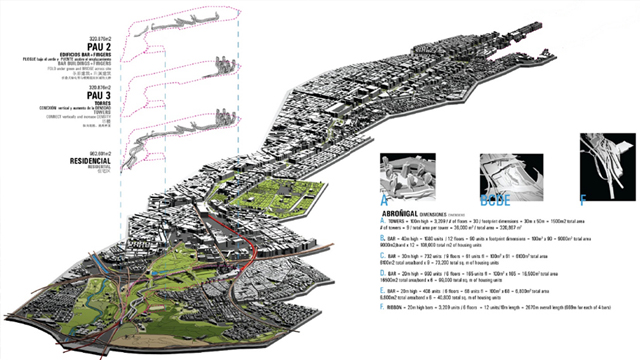
2_ABRONIGAL
The second site is the current location of the Abroñigal Cargo Terminal, located southeast of the city, sandwiched between the M-30 and M-40 highway rings around Madrid. Located along the RENFE corridor, the regional rail ofMadrid, it is 204 Hectares (70 hectares used as a cargo shipping storage facility able to hold 3,000 TEUs (1,500 common 40’ containers). 15 trains arrive and 15 leave per day. The Abroñigal-Madrid terminal was founded in 1974 to act as a cargo depot.
Already underway are plans to construct a new Abronigal station by 2020, moving the principal train station of Madrid from the central Atocha station to the southeast in order to drastically alleviate traffic on the North-South axis of the city (the Castellana). By transforming the “station of containers” into a public rail station of the high speed Spanish train (AVE), the city hopes to reactivate the site and surrounding area, currently one of the least economic of Madrid. The site is 70 hectares, more than 4 times the size of the as 17 hectares of Atocha. Neighbor associations are strongly against such a relocation as well as city officials who believe it necessary for Madrid to retain a central station, similar to the Gare de Nord in Paris, the Waterloo in London or the Central Station in Amsterdam. In addition, the AVE stations of Barcelona, Seville and Malaga are all centrally located. The new station of Atocha would remain open but desaturated. Of the 34 million projected travelers in 2020, 24 million will then embark from Atocha and 10 million from Chamartín, through a new underground tunnel that will connect both stations. The Túnel Atocha-Chamartín, would allow travelers just 10 minutes to get from Atocha to Chamartin, saving 21% of time. It will allow for much needed parking for cars, buses and other infrastructures. The project anticipates duplicating the capacity of parking of trains, from 15 to 33 routes, and will also triple the parking spots to 3,500 from 1,000 presently. The mayor and City council are looking to promote lucrative uses necessary to defray partial or total cost of necessary works. This new southeastern “gate to the city” is an investment of 900 million.
3_CUATRO VIENTOS
The third site is currently the Madrid-Cuatro Vientos airport, the oldest of all Spanish airports around since 1911. Located just eight km Southwest from the centre of the capital, it is a joint civil-military aerodrome used for general aviation flights. In 2005, there were 64,657 flight operations. The current paved runway is 1,500 meters of 10-28 orientation and 30m wide. There is also a non-paved runway, of natural ground, which is for exclusive use and rights of the air base. The airport had 193,553,178 annual passengers in 2006 (+6.8% from 2005), 2,318,525 operations (+4.9% from 2005) and 613,602,370 cargo shipments - imports/exports (-0.5% from 2005).
Despite its climbing numbers of users, Madrid-Cuatro Vientos airport is being scrutinized by the city as a possible site for further residential development. The associated metro stop, ALCORCÓN-Puerta del Sur, can be translated as “door to the South”, an appropriate name for its location, as one of the last open developable areas inside the city boundaries. Almost completely flat in terrain, this site offers many possibilities to serve surrounding areas as well as its own development.
Sources:
http://www.psmpsoe.es/docs/repositorio/imaginamadrid/cercanias/index.htm
http://www.airports-worldwide.com/spain/madrid-cuatro_vientos_spain.htm
http://www.madridplataformalogistica.com/index.php/mpl/acerca/mpl/madrid_plataforma_logistica/infraestructuras_y_servicios_logisticos/estacion_de_abronigal
http://estadisticas.aena.es



Comments are closed, but trackbacks and pingbacks are open.